
Leave a Comment:
43 comments

This post reminds me of something I read by Ursula LeGuin…
…She said when she was young it was not handsome guys that turned her on but guys who used words that she had never heard before…


The best and worst thing about modern slang is that often words are understood only by a particular group in a certain demographic at a certain point in time.
If you know your market will respond to slang that is emotional and meaningful, do it but realize that you will be eliminating or turning off most of the world who does not talk like that. I guess some people will make big money with focused targeting if they have great copywriting skills.
Reply It’s not hard to know what words resonate with your market. In fact, if you DON’T know, you’re not doing good marketing.
Too many writers focus on the readers who complain. Quick tip: Your best customers won’t complain, and often won’t give you a thumbs-up, either — they just buy, and spread the word to colleagues.
Sell the foxes, not the dogs. (Quote from Halbert)
Reply
I totally agree that Dave Barry has such a great way of using the English language. I still have a couple of (highly yellowed but hilarious) clippings from his columns. The one about his experiment with a can of Rave, a roller-blade Barbie and a pair of boys underwear always makes me laugh.
He still maintains a blog on the Herald website. I try not to go there too often as I end up wasting at least an hour.
Reply I didn’t know about Barry’s blog — thanks. I’ll go check it out…
Reply
The Retirement of Dave Barry from writing is is a sad day. He was actually funny . Modern society’s idea of humor is pathetic
Reply
I Don’t know if I agree with you James. People like to feel hip and cool. I know when someone uses an acronym that I never came across, but I figure it out on my own, I get a warm fuzzy feeling inside. If I come across slang that I decipher, I feel cool and hip.
I think using the right slang will make people identify with your writing, even if that slang isn’t a common word they use.
Old people can drink Pepsi even though its for the new generation. Marlboro always targeted men, yet has most of the female smoking population.. Just because your marketing targets a specific audience, doesn’t mean it excludes other consumers… After all, people are very complicated and relate to (and/or want to associate with) all sorts of things outside of their stereotype…
Of course there are times when using slang could be a mistake or taken offensively, like when you as the writer are an outsider trying to fit in and the reader sees right through it…
With all communication you need the content to match with the writer and the reader.
Reply Actually (interesting story) Marlboro started out as a women’s cigarette, but failed. So it was reborn, almost as a joke, as a super-macho cowboy smoke.
The image of the cowboy was a sort of slang, too… shorthand for “takes no shit, has adventures”…
Reply

Thank you, John. You’re so right — this is a wonderful treat.
Reply
Wow–I remember running my writings through one of those assessment things that determined what level they were at. I was found to be writing at a 5th grade level even though I was in college, same thing happened again recently on my own website, and I recall feeling disappointed. I didn’t know that was the ideal!
The problem with teachers is also that schools can be pretty strict on HOW they are permitted to teach. The system is braindead, more than most teachers.
Reply It’s all about communication, Bluestar. The best writing always, at it’s foundation, simple and direct. You can add better power verbs as you go, but start with the basic story. Another tactic: Talk to me like I’m 10 years old. Seriously — if you’ve ever been around 10 year olds, you know they’re wicked smart, very sensitive to how adults think, and totally attuned to the culture. They just have a more compact vocabulary… which is the best way, still, to communicate clearly.
Reply
His writing is really gross and crude but his use of language is worth studying. I’m talking about Tucker Max. Just finished his second book and the man is a master of gross and disgusting but the language is high art.
Reply Harlan also turned me on to Jean Sheppard, of “Christmas Story” fame… being on the west coast, I never heard his radio stories, and I love his books now. Must-reads for writers. Thanks again, Doc…
Reply

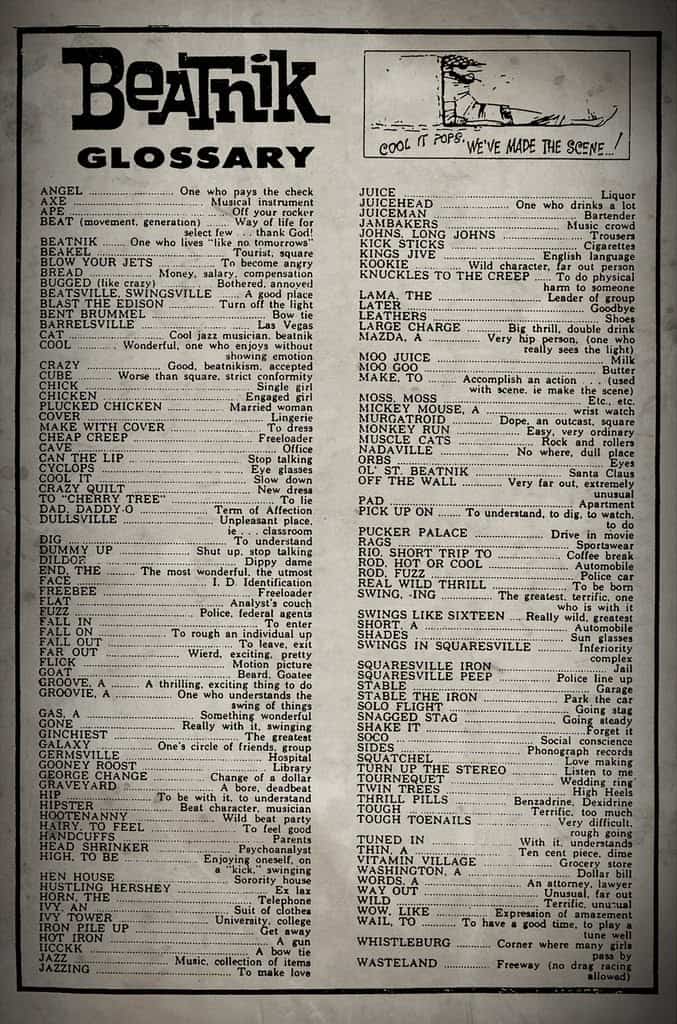
What goes around, comes around, Mike. My own vocabulary is so loaded up with slang from different generations that I have to be double-aware not to mix ’em up too much. Using words like “swell” (from the 30s), “groovy” (60s), “ha-cha-cha” (40s), “sick” (90s), “cyberpunk” (80s), etc, can create a verbal stew that confuses the uninitiated…
BTW: I picked up the old slang from watching cartoons obsessively as a kid. I was entranced with the Max Fleischer studio stuff (Betty Boop, Popeye) from the 30s, and Warner Bros. from the 40s (Bugs Bunny)… it startled my folks to hear me speaking in slang from when THEY were kids…
Reply
Hola,
Do you have a current resource for ancient slang like the gumshoe detective would use? Looked for one on Amazon and was befuddled.
Lo (Brat)
Reply
Slang is tricky. What we understand when we’re talking with each other face-to-face is one thing, but slinging slang at our marketing targets can just as easily turn them off. Especially if they’re just a bit (or more) younger than us. Then, if we don’t use the slang just right we come off sounding lame and out of it. (Or whatever it is those dratted kids are saying these days!)
Reply
Are you looking for straight verbs? This might be a redundant question…
Also, David Sedaris first chapter of Holidays on Ice is fantastic. He auditions to be an Elf in NYC at Christmas time.
Reply

G’Day John,
I know that it makes me sound old-fashioned, but I learnt so much from Robert Gunning. His “Technique of Clear Writing was first published in, I think, 1962.
He doesn’t address the issue of using slang. That comes naturally to we Aussies anyway. But he does have 10 principles to follow.
My favourite is “write to express, not to impress.” “Write the way you talk” is another I try to follow at all times.
You’re probably familiar with his work. But it’s always worth mentioning as we struggle to keep afloat in an ocean of waffle and hype.
Best Wishes
Leon
Reply
Wow, you just pulled some questions I had out of thin air, waved your magic scarf and pulled the rabbit out of the hat.
I was searching for some humor writing to study for getting the voice right for my blog. As well as a way to get around slang words for those who don’t know what social media is yet. Thank you.
Definitely agree with you on falling in love with the language to express. I’m learning good use of language from reading fiction by Neil Gaiman and TC Boyle. In my opinion, they express language fluidly.
Reply Good luck on finding your voice, Gabrielle. That’s the key to becoming a “real” writer, beyond being a hack (though the world still needs hack writers, too). Finding your voice opens up whole new worlds of communication possibilities…
Reply
John,
Lovingly and powerfully presented. Always, always something for my treasure trove!
Reply
I realised, I’d stopped breathing halfway through this. My brain went into hyperdrive finding suitable homes for “eye-wreck” and “Blackberry prayer” and gave up on lesser necessities such as inhalation.
Must write now…
Thanks John. As always.
Niki

Great resources. Thanks.
Sometimes we forget about the older masters of our craft, like Mark Twain. He not only had a way with painting word pictures in my mind, but his mastery of dialog put the reader right in the middle of the action.
And Twain is only one of many that inspired my love of language, turning me into another “word slut” 😉
Reply
Thanks for those links to other examples of good writing John.
I am an old survivor of a British type of education and a life in the colonies. When first arriving in North America I thought that a very different type of English must have been taught in schools here.
Fortunately I found your blog and my faith in the future of good writing was restored.
Thank you
Some of my favorite word sluts are British — going back to Monty Python, up through Eddie Izzard and R. Gervais…
Americans seldom realize how CHEATED they are in this crimped education system. The English language is the richest one on earth, easily adaptable to slang and new words (unlike the Latin-based languages, which have to do gymnastics to avoid incorporating slang or English)…
… and yet the average American’s vocabulary is a weak-ass stingy mess. Wizards like Dave Barry make the most of it, but he relies on words that Americans recognize, but don’t USE in everyday life.
I see signs of change, though…
Reply
Agree with points re straight writing; though I find it’s a challenge to write at 5th grade level since I have two degrees; so I miss a lot of my potential mass market (many of my customers are engineers/doctors etc, since I write to that level educated group).
Right usage of slang is essential; that’s relatively easy.
It’s tough sometimes to ‘make it basic’ and to write in a way that’s easy to read (particularly important since many customers have english as second language, from other countries); eloquence and articulation are elicited with more specific, advanced words that convey shades of nuance better than ‘basic’ words, though that’s the right approach for mass appeal. It’s still a challenge.
Good tip to read columnists, they do a great job of relating in a way that’s easy to understand.
still like to use my 5-syllable words but not making as many sales as I could because of it, tho (part of it is admittedly classist, I like to be high faluting sounding, as aristocracy should be; though that’s not the best approach to connect with the masses) –
-k
Reply
This is why I keep coming back. Great resources, and I always click away knowing more than when I clicked the link that brought me here.
Kinda like going to the bar, but I don’t always remember what I learned there.
-Dana
Reply
It reminds me of Barry Zinsser when he wrote: “Clutter is the disease of American writing. We are a society strangling in unnecessary words, circular constructions, pompous frills and meaningless jargon.”
Reply
Apart from Dictionary.com, Doubletongued.org is one of the best things online…
Reply
I was like blown away by your post John.
(51-yr-old emulating current young person – well actually I’ve also heard people my age using “I was like …” … cringe.
I love language and good slang, but hate the abuse & laziness that is an excuse for self-expression.
Thanks again for the brain-stimulation!
Reply
Hi John,
Freakin’ awesome blog post. I’m constantly looking for ways to reach my audience and the sites you point out are priceless.
This is totally off topic, but would it be too much to ask for you to put a favicon on your site so it’s easier to spot in my bookmarks? Just a thought…
Reply

Thanks for the awesome post (I love me some Dave Barry). I especially enjoyed (enjoy? because I’m still on that page) the doubletongued website.
What a goldmine that is! Thanks!!!
Reply
so now the word slut has gone so far that we literally needs to rethink about it and by the way I wonder how you even dared to write a whole blog spot on this one word?:P But thanks a lot for such a nice and awesome post.
Reply
John,
What a brilliant piece of content…
I will have to say the headline truly hooked me into reading it…
Seriously, who in there right marketing mind could resist.
I have to added it to my marketing bag of tricks..right besides my “Power Words” report you totally hooked me up with inside your simple writing system…
Keep knocking out the killer copywriting content…
Jesse
Reply
I got to this post by following a link. After writing for scholarly journals for 30 years or so, I started blogging. I fully realized that I’d have to write shorter sentences and adopt a more conversational style. I’ve enjoyed reading and learning from you and previous commenters. I will be back!
Reply
“Sell the foxes, not the dogs. (Quote from Halbert)”
To cool!
Reply
[…] http://www.John-Carlton.comIf you love language — and you should, as a marketer whose main job is irresistible communication — you’re gonna appreciate this. […]
Reply