Monday, 6:16pm
Reno, NV
“We’ll meet again, don’t know where, don’t know when...” (Omnipresent WWII song by Vera Lynn)
Howdy…
A big part of the mojo I bring to the consulting table is simply that I survived a fairly wild-ass lifestyle before and during my career…
… and took notes.
I come from a family of storytellers, and it’s always been second nature for me to concoct the way I’d relate the story of any adventure I was involved in… often while I was experiencing it. More likely, of course, the lasting model of any story came together over a few tellings, as I tossed out the boring bits, highlighted the more exciting or outrageous sections, and found that sweet spot that ended the tale like a punch line.
You don’t get away with aimless, pointless or dull stories in a family like mine. You either grab attention, hold it, and deliver a rollicking good telling… or you get swamped by a better story from a frustrated listener. Best possible training in the universe.
And I can’t think of a better segue into an advertising career. Humans are hard-wired to crave, love and remember well-delivered stories because before the written word, memorized stories were the primary form of sharing information. And persuading folks. And molding the contours of a socially coherent civilization.
Most of us are not great storytellers, however. It’s not a default setting in our brains… and if you don’t hone your chops, you’ll remain a naif at it.
However, if you DO choose to get hip (and I’ve got a ton of posts here in the blog archives on this very subject), then you get past the hulking bouncer at the velvet rope and into the “great storyteller” party.
I actually used to do that, by the way, as a hobby. Talk my way past bouncers. The last time was at a casino, where the Van Morrison concert was sold out. I had a cup of coffee and walked briskly toward the bouncer, saying “I got that coffee for Van” as casually as I could. The guy waved me through. Heck, other folks standing in line stepped back to let me past. I stepped into the venue, and just slumped.
“I can’t do it. Look, man, this coffee isn’t for Van. It’s just a cup of coffee.” The bouncer blinked at me. I wandered off, the fun gone forever in that game. Heck, it just got too easy.
Now, good consulting is also a form of storytelling. Usually, my client comes to me with a mishmash of complaints, problems, nightmares and quandaries… and none of it seems to make sense.
However, I learned long ago that almost everything makes sense when you get the right perspective on it.
But it has to be the right perspective… and you gotta be aware that, most of the time, your shallow brain activity will just accept the first nonsense that comes along to relieve the broad sense of “not knowing what’s going on” (which is causing most of your discomfort).
It’s a good example of how solving the “outer layer” (or symptoms) of a problem doesn’t actually solve the underlying problem… and so, while you may feel better with a weak explanation of something, it won’t help you move forward.
For example: The other folks in line when I swept past them into the concert all were presented with an “unknown variable” to their evening. Who was that guy? What did he say to the bouncer? How come he got in while we languish outside here? And why did he go in, turn around and come right back out?
This is ripe territory for rumors and gossip. In many cases, anything will do.
The tension is in the “not knowing”. It’s a voracious beast in your head, and often any old clump of garbage will satiate it. Was the guy delivering drugs to the band? That was the lighting guy, wasn’t it? Hey, wasn’t that the bass player?
Or even: Did you see that guy just walk in? I’ll bet he bullshitted his way past the bouncer…
True or not, the contours of the story need to be filled… even with temporary landfill (like rumors) that may be replaced later.
In business, this need for resolution often backfires. You may decide your bottom line is tanking because people are broke now, or the competition is doing something evil, or it’s been raining, or whatever.
And your “decision” to believe any of that may be complete nonsense, unrooted in reality. Yet, you buy into it, because it’s convenient…
… and it doesn’t hurt your ego.
Hey, I’ve been there. I’ve sent out ads that bombed, I’ve hosted events that were ill-attended, created products that drew big yawns from the marketplace. It happens in any career that lasts longer than a month.
And I’ve watched myself go into “justification mode”… where all kinds of great excuses become obvious, and I don’t feel so bad. Gary Halbert and I used to do it in tandem, in fact… for about half a day.
Then, we’d realize what we were doing… kick our ego’s out of the room… and give ourselves a big damn reality check.
This is the basis of the old saying that entrepreneurs never “fail”… they just encounter another learning situation, and move to the next step wiser, broker and ready to get rich again.
But you’ve got to FIND the lesson in any failure. Then really learn it. And then APPLY it to your life and biz.
This is why I get paid the Big Bucks as a consultant. I’ll listen to your rationalizations, excuses, and “ego-friendly” justifications for why a project has gone sideways…
… and then I’ll host a quick Reality Check with the client. To find out the REAL REASONS behind the pain.
Your prospect list isn’t broke. It’s just no longer willing to pay your price anymore, cuz the competition is undercutting you… as they should, since you started out with no competitors and priced your stuff high, and now that game is over.
Just for example. (I actually encountered this rationalization in a consultation recently.)
It may hurt to realize that you need to change… cuz our lizard brain just LOATHES change, in any form or for any reason… and you are forgiven for allowing soothing rationalizations to cloud the real issue.
But this is business. It does’t operate on what you want, or what you wish for. It operates in the cold, cruel reality of the way things really work.
And once you get hip to this tactic, you can actually peer into the future…
… and have a decent shot at being right.
Our culture is awash in prognostication — the “art” of predicting what’s gonna happen next. It’s a great gig in politics, cuz no matter how often you’re wrong, you never pay a price. There are zero consequences for being a talking head, or a newspaper columnist, or a Senator and being completely, 100% wrong on a prediction. You just shrug, mutter something about “unforeseen circumstances no one could have known about”, and move along theatrically to the next wildly incorrect prediction.
It’s the same in business, unfortunately. Over the last many decades, there were several biz guru’s who put out special tomes every year on what was gonna happen to the stock market, to biz opportunities, to real estate, to technological breakthroughs, to social behaviors…
… and while these books and reports sold like hotcakes, they were spectacularly wrong on nearly every important guess. (Lookin’ at you, Faith Popcorn.)
In fact, these “guru’s” were actually operating on an age-old con model: You get attention with outrageous predictions that start the rumor mill grinding, collect your fees for the show, and then make yourself scarce when the results come in.
So public predictions of the DOW reaching 36,000 (back when it was hoving around 2,000)… of AIDS cutting the US population in half within the year… of computers imploding at the stroke of midnight on January 1… or of California sliding into the ocean… (all of which were touted as “legitimate, substantiated predictions by an expert” at one time or another)…
… were met with excited chatter by pundits, investors and a public eager for scandal (and for bad things to happen to people they didn’t like). Book royalties zoomed, appearances on talk shows spiked, and anxieties rose.
And when the predictions failed to materialize… well, bummer, dude. Big shrugs, no consequences, and most folks just moved along to the next shiny object.
I’ll even wager this kind of prediction-failure-no-consequences routine has gone on since the caveman days. Every culture has soothsayers, shamans, psychics, witch doctors, mediums, and oracles… all earning their living by predicting shit.
And they only need to be right once in a while. Their astronomer buddy can slip them the date of the next eclipse, or they “cold read” someone’s grief (“You miss someone terribly…”), or they just stumble on a correct prediction despite being wrong a thousand other times. The human mind is so bent on believing the future can be foretold, that folks will ignore obvious silliness and grasp at even dumb predictions like drowning men to a log.
So, the fundamental rule for anyone hoping for a glimpse into the future: Don’t listen to the professional prognosticators.
Instead… just get hip yourself to the basic tactics of legitimate future planning:
Basic Tactic #1: Past results may, indeed, be an indicator of what’s coming.
There’s a great old saying in self-help literature — “If you don’t change your behavior, then the next five years will probably look very much like the past five years.” In other words, if you’ve been broke and fat and lazy for a while, and you don’t get busy with a new plan… well, you’re looking at a future of being broke and fat and lazy.
Not rocket science. But profound in it’s own way.
In business, I often see consulting clients who had hit it big at one time… and are so pissed off that the market has changed, that they waste all their time complaining. And not changing what needs to be changed for the New Reality they’re doing biz in.
You’ve probably heard of “sunk cost theory”. It’s the observation that a biz owner can get frozen over how much money he’s already put into a project… and thus refuses to stop putting money into it. Sort of like how gambling addicts keep pumping coins into a slot machine that ain’t paying off, in the belief that they can’t walk away until they win it all back. (Yeah, that’s a great plan.)
This is why one of my most-used tools in consulting is, unfortunately, to be the guy to tell you that you need to let the project die, and move on to something else. Nobody wants to hear that, but then that’s how I earn the big bucks. By telling the truth.
I can look at cold numbers and results, and see that nothing much is going to change. The campaign worked before, and congratulations. It ain’t working no more, dude. Time to move to the next game.
Interestingly, this basic tactic also works with successful projects. Often, a biz owner becomes bored with his ads… and because he’s seen them so many times, he’s sick of them. And wants to change. Just because.
And I look at the past results, and see that the campaign isn’t anywhere near exhausted. And that this winning ad arrived in his life after a series of doomed ads… so my advice is easy: Stick with the winner. Keep testing against it, and when you find one that BEATS the winning ad, then change to that.
But don’t change just because you’re bored with your ad. Let results be your reality check.
Basic Tactic #2: Fill in the blanks.
There’s a classic South Park episode where gnomes are stealing underwear from Tweek… and when confronted, reveal their plan:
Step 1. Steal underwear.
Step 2. ?.
Step 3. Profit.
The key is that Step Two is obviously a glaring hole in the plan. It’s funny — anyone can see that a plan missing the essential link between doing something and making money is sheer nonsense, right?
Not so much, it turns out.
I often encounter entrepreneurs whose plans are essentially this:
1. Create a product.
2. ?.
3. Profit
Even worse, they’ll hear that they need a website, or need to get on Clickbank, or need a “video sales letter”, or any number of things that are beyond their current know-how. So they throw money at a programmer… or a kid who figures out how to toss something up in Clickbank… or a copywriter who claims to be an expert in VSLs… or, worse, they buy into some scheme that promises magic solutions like SEO, or lead-sharing, or (my favorite) “selling without selling”.
They may have an excellent product or service. Best in the universe. But if they can’t figure out HOW to sell it, then they’re headed for oblivion. The world will NOT beat a path to your door if you invent a better mousetrap. You’ll lose to the guy who learns how to market his own (maybe inferior) version.
So, when peering into your own future, the main question is easy: Where are the blanks?
Where are you weak or completely clueless? Write out every step in your business from waking up tomorrow, through manufacturing/distribution/advertising/lead-generation/etc, through using a merchant account and CSM software, through creating back ends and further relationships with each new customer.
Oh, and also taking care of returns, and dealing with new competition that lowers prices and steals your prospects, and on and on.
Maybe you’re a total rookie, and most of this is just babble to you right now. That’s fine. We all started out clueless and lost and full of ideas that require knowledge or skills beyond our current toolkit to work.
It’s a process.
Your next step is to discover the first thing you’re not thinking about or dealing with yet, that you should be. And get hip to what it entails, and how you’re going to handle it. Research it. Start with a Google search, read up, maybe read a book on the subject, find a forum online dealing with it.
It’s kind of like deciding between an Android phone and an iPhone. An experienced friend may be able to predict that you’ll end up with the Android because of price, for example… way before you have a clue yourself. Because you don’t even know the cost differences yet. So while, at first, that experienced friend of yours may amaze you with a prediction that you’ll end up with the Android (cuz he knows you’re a cheap bastard)…
… with just a smidgen of research, you will arrive at the same conclusion. Without magic.
So, if you’ve never had a website before, it may seem like the most daunting task in the history of mankind. You don’t even know the first step to look for, let alone take. Your ability to “predict” what your online presence will look like is a big blank — you have zero future-peering power.
But after you get your first one up (probably with help), you’ll be light years ahead of your old clueless self… and when you decide to put the NEXT one up, you may be able to “predict” with precise detail exactly how it will look and function.
Again, no magic. No voodoo. Just experience and knowledge lighting the dark ahead of you.
Does this make sense now?
Most people look into the future and immediately see nothing, and give up. It’s a wasteland of possibility, ruled by gnomes and alchemy and rude gods who just like to fuck with humans.
But experienced marketers see clearly much of what’s ahead. The details may rest on things they can’t predict (like an earthquake in their target niche, or UFOs capturing all distribution centers), but they don’t pretend to know those things. No marketer tests prices for the fun of it, for example — we test because we want to know how the market will actually react… and our intuition or guesses or informed predictions don’t count until proven in the real world.
Looking ahead and mapping out what you know, versus what you believe, versus what you don’t know, and versus what you can’t know…
… is a GREAT map to start with. You know where the blanks are. You know when you need to wait for results to make a next move (but you’ve already thought out different moves based on those results)… and you know where your next research project starts.
You know, the great crashes and political disasters and spectacular business failures of recent years were NOT unforeseen by a rather large chunk of the population. It’s just that the folks sensible enough to look ahead and fret don’t make good guests on talk shows, and their books tend to be boring.
There is NO need to make up outrageous stories about your own future. And it’s suicide to just ignore it.
I start out with one assumption: Something is going to happen to me tomorrow.
After that, if I’m so inclined, I can actually construct likely scenarios (with known blanks I need to research or watch for) and map out a plan of action that relies on no magic whatsoever.
And sometimes, I just let the days come, and enjoy the adventure.
But in business, I like to have a clue.
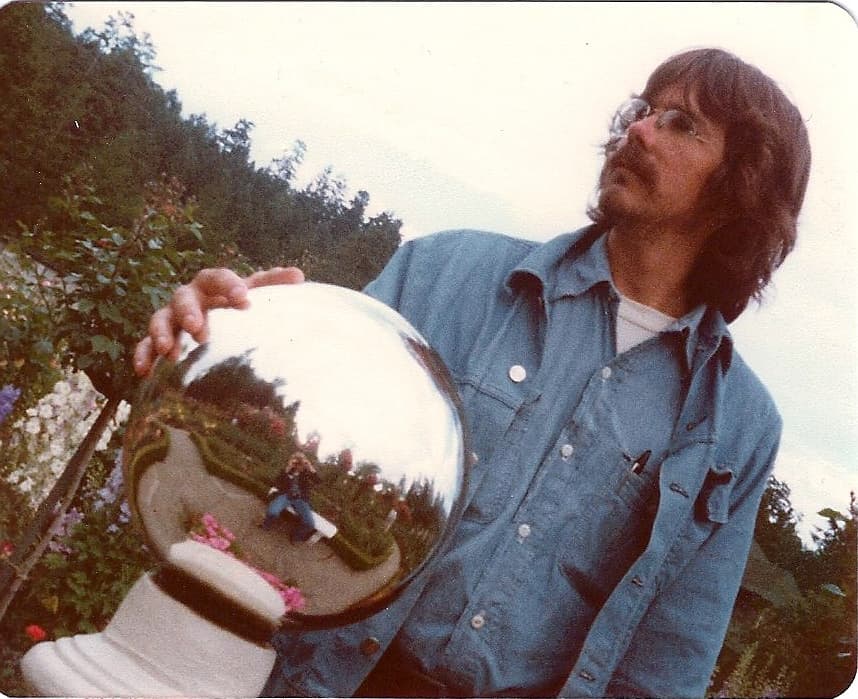
My crystal ball is made with facts, observations, reality checks and known previous results.
What’s yours made of?
Stay frosty,
John
P.S. Did you buy my book on Amazon yet? It’s a few measly bucks, and it’s a REAL ebook, too. Over 250 pages packed with advice, tactics, insights and success-secrets.
It’s called “The Entrepreneur’s Guide To Getting Your Shit Together“, and you can buy a copy here.
Do it. Just stop whining and get your copy now. It’s already essential reading for savvy biz owners, and you better hope your competition hasn’t already got their copy before you get yours…